Showing posts with label garden project. Show all posts

Friday, 19 April 2013

Castle Garden Mushroom Growing

(Mushroom Blog thanks to Jack Cox, started our mushroom logs and did a workshop about it!)
 
The Castle is embarking on mushroom cultivation in it's gardens! We're using the age old technique of growing mushrooms on logs which was developed in Asia over 1000 years ago. The particular types we're trying to cultivate are the tasty Shiitake and Lions Mane which are native to China, Japan and Korea but are becoming more commonly cultivated in Europe and the USA. Growing mushrooms on logs is the most low maintenance method of cultivation and although it does require patience (and some maintenance too!) can give good yields of between 20% and a third of the dry weight of each log and is less energy intensive than other methods. We've inoculated our spawn into hard hardwood - oak for the Lions Mane as they don't do so well in paper-bark trees like birch and silver birch for the Shiitake. Because of the oak and birch's density we can expect yields for a longer period. 

 Now we've inoculated the logs with spawn, we'll have to wait anywhere between 9-12 months to get our first fruiting. This period before the first fruiting varies depending on the climatic conditions. We're storing the mushrooms in a custom built incubation house with opening roof slats for ventilation and letting rainwater in to water the mushrooms and a sand pit for trapping moisture in the logs. Once we see signs of mycelial rings on the ends of the logs we can 'shock' the logs which means submerging the logs in water for 24-48hrs. This process of shocking induces the logs to start fruiting and can be repeated up to 4-times per-year for 5-8 years running.

Cultivation on logs is great for many reasons. You can use shady space which is often too dark for growing plants, you can stack the logs to make use of vertical space wherever you're growing and recycle wood from tree surgeons that may otherwise go to waste. It is a method of cultivation that can be explored on a variety of levels from large scale commercial farms to small scale home growing. We got our spawn from Ann Miller in Scotland who doesn't use chemicals and produces hardy strains of spawn for cultivation. There's lots of information on the internet and in books to get started if you're interested...and if you don't have much space you can grow on other smaller materials like corn cobs, coffee ground, paper, cardboard, straw and sawdust...and if you're still unsure, come down to the Castle for our Thursday and workdays to find out more about organic urban horticulture!
shiitake on oak log at Jack's house


Castle Garden Winter 2012-2013


Most of our winter, from December until March was spent freezing our fingers off. To keep our spirits up we put our backs into necessary and warming manual labour.

December and January saw us replenishing last year’s paths with chip from some charming local arbours. Once the old paths were finished we then moved into new territories. With our Wassail workday dedicated to construction, we now have walkways that meander downwards, over greenwood stairways, into the forest garden.


Following this day in January, moving and shifting, digging and chipping, we celebrated with a bonfire and our ritual wassailing. Lead by volunteers Emma and Victoria we sang to the fruit trees, coaxing them into producing an abundant harvest. We laid focaccia in their branches along with a little cider, just for good measure!

Rolling with the hill to the back fence, these new paths offer easy access to our ever growing green wood stack and avenue of twine trained berry bushes. Past the common black berry that rubs shoulders with the exotic Japanese wine berry and elongated loganberry, the path runs smoothly around our young nut trees to the busy habitat corner and ice crusted pond.


In February we began our big winter project: The Garden Shelter. Two weeks of construction work Managed by Barry, Crafted by Tom, and Laboured by a mixed mob of hardy volunteers and staff working through sun and rain…of which there was both!

Before construction could start, the team had to first move the body of sweet chestnut round to the back of the garden from the delivery point, which of course was at the front. Eleven uprights stacked on eleven roof beams, and an army of shorter pieces for henge beams and rafters.

To manoeuvre the 10-12ft monoliths took six people per lift. Many calculations were made in this process about horse power. How many people were equivalent to one horses power…Then we found some wheels, and technology evolved.  We settled on a complex method similar to a medieval battering ram. The construction was mastered by one of our volunteers, the mighty Max, whose skill on the reigns was vital as we rolled along and down hill on two tiny, ancient wheels we found rusting under a tree.

Men, women and children were roped in, as well as some unsuspecting passing climbers who made the mistake of stopping to ask what we were doing.


Once round the front the huge posts were either used as uprights or saved for roof beams. Sitting deep in their 90cm foundation hole Barry regularly noted that they wouldn’t be going anywhere! The posts were secured by compacted rubble and connected by sturdy henge beams.


These henge beams were cut to perfection by Tom, the site carpenter. Then delicately pinned to the uprights using the usual tools: an arm length drill bit, a persuader (also known as a hammer) and some metal rods. The rods were found in the rotting cable wheels that had been dotted around the garden as tables for a few years. The task of removing them, by smashing up the reels, seemed to cause great excitement in the volunteers.

Using power tools in general seemed to make our volunteers very happy. As you can see as Maddy happily drills down rafters. Intrigued as to what was so fun, Fionn, her loyal and dexterous hound concluded that the ground must be second rate, decideding he too wanted to be elevated.


It was a bit of a dog playground this work site. Causing time delays as everyone would stop every so often, to coo over one canine or other. You just couldn’t help yourself! The winner for stopping the most workers had to be, paws down, Madeline’s new pup. (Yes we had two volunteers with same name!) Who, due to its exuberance and youthful charm, was somewhat shunned by the older Fionn, leaving it only us to play with. 


Mean while, Rosa, our Architect joined us when she could through out the build. Sometimes helping with construction, or sometimes taking time out to plan the next architectural must: such as this bespoke sofa made from locally sourced off cuts. Not only this but on a Saturday she would feed us with left over sandwiches from her work. Ah the good life.


All in all I think the masterminds were happy with their work. Us labourers all learned something, and we have the beginnings off an amazing garden shelter…all we need now is a rain proof roof!
 The green roof should be on by May. Recycled bouldering mats will serve as a waterproof layer, then soil. Eventually we hope to have tea herbs growing here, making it and addition to our productivity as well as protecting us from the elements.
All in all it was a creative and constructive winter. We fixed unruly vegetable beds, we added more vegetable beds in the unused space between old vegetable beds, we re used and recycled everything from windows for propagating to plywood for shelter walling.

In between constructing, we re-dressed the herb beds, mulched the fruit trees and suppressed the slightest suggestion of unwanted growth in the swale.


The garden is ready now for spring… and so are we!

(Our winter Blog was written by Min, our garden events organiser who got everyone together to build the shelter!)

Saturday, 9 February 2013

Castle Garden Autumn 2013


In between that warm time and this slightly colder snowy time, lots of exciting things have happened in the Castle Garden. In early autumn, as the summer flowers began to die, our team of staff and volunteers were out seed collecting.  Although we weren’t the only ones! The birds, fearless of our giant scare crow, and its miniature underlings (mainly aimed at slugs), ate all the sunflower seeds, massacring the giant heads in the process! This means we will have to rely on seed swaps if we want more sunflowers brightening up the edge of the Forest garden next season.
We did get lots of other seeds however and by removing the dried seeds from dying plants we will be able to propagate seedlings in the spring and control the spread of the more prolific plants. This also meant that we have been able to swap and sell interesting flowers, such as Cosmos and Dahlia Roxy at our events to local budding gardeners. The coriander and fennel seeds even made it into the kitchen!
As the seasons changed, so did our activities. Moving around being a priority as temperatures crept down and sunlight dwindled. There was a lot of clearing of dead plants and left over scrap from the busy summer as well as a seeming endless amount of leaf raking. Our brave rakers spent hours tidying up leaves and barrowing them, against the wind, to our newly organised leave mould area, just to return the next day to a fresh coating on the grass!


England’s best event over autumn is obviously Bonfire night, so in respect for this dramatic occasion we held a Bonfire workday, with wicker men, a roaring pizza oven, and of course a massive bonfire.
Spring bulbs were planted in the day, all over the front hill, where the old sign used to be. This will look amazing from the road and from the garden when the fresh shoots, then flowers, line the hill in spring.


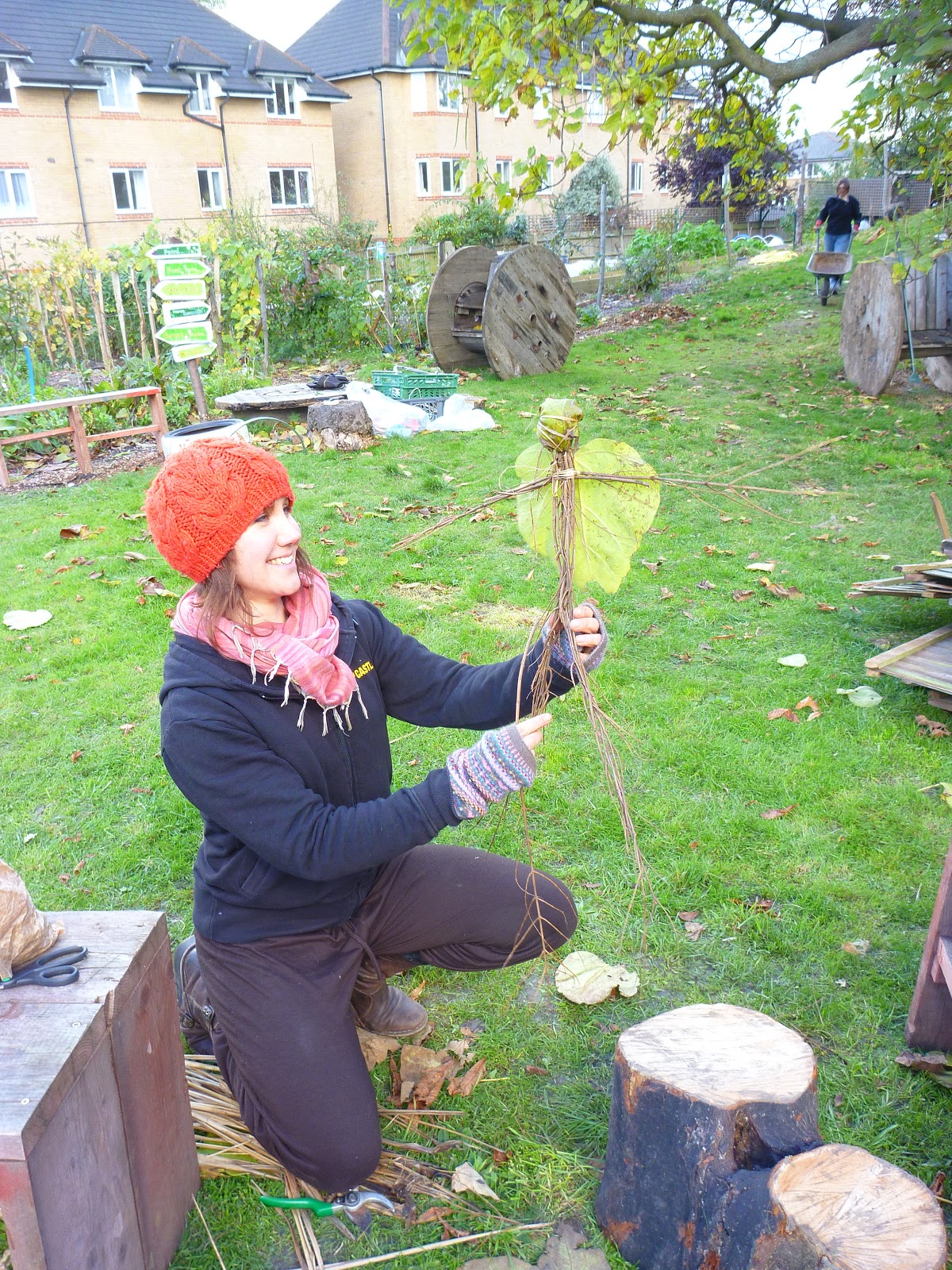
Elsewhere in the garden Lauren used her creative talents to construct an army of beautiful stick men with a variety of heads from leaf bundles to conkers…or even snails. Inspiring the children (and adults) with an effect that was somewhere between disturbing and really cute!
Barry of course took charge of building a monstrosity of a structure that made our fire pit look like a tea cup in the hand of a giant. 
The turnout for this evening was brilliant, with everyone revelling in the excitement of building men and women of sticks… then burning them.


The crowd got so carried away that even our scarecrow, in its staff uniform, vanished in flames!
The end of the growing season was a busy time for herbs. Even though we harvest throughout the spring and summer, in the autumn we finally had the time to get on top of processing and packaging. This year we decided to sell the excess of herbs that the Castle kitchen could not use. So, on the run up to Christmas, we had a small ‘shop’ on the counter of the Cafe selling produce marked as castle garden grown  , with a menu telling customers what was available and explaining a little about the garden and its ethics.

The ladies: Veronica, Claudia, Victoria (and sometimes Barry), spent a couple of rainy days working on the presentation of our produce. Either packaging dried thyme, oregano and sage or creating herbal bath infusions of Rosemary and lemon balm!
The tea front saw Nick experimenting with exciting new blends of mint, yarrow, elderflower, rose, lavender and calendula flowers. Whist our in house sewing master: Doug needled away making hops pillows and lavender bags. 
There are still herbal teas on sale on the counter as well as seeds for spring planting, if you’re lucky you may even be able to snap up some of our special garden Honey!